Organic sleep materials · A practical guide
Inside the Healthy Choice Sage Dunlop Latex: Feel, Materials, and Fit
A latex mattress can feel buoyant, firm, or gently contouring depending on how it is built—and on the person sleeping on it. Here’s how to assess the Healthy Choice Sage Dunlop latex model, what to verify about its materials, and which questions matter more than a label or a firmness number.
Buying a mattress often begins with a deceptively simple question: Will it feel comfortable? With latex, the answer is shaped by several variables at once: the latex formulation, the number and thickness of its layers, the firmness of each layer, the cover, the support beneath it, and the sleeper’s body and habits. “Dunlop latex” tells you something important about the material and how it is made. It does not, by itself, tell you whether a particular mattress will feel soft, firm, or right for you.
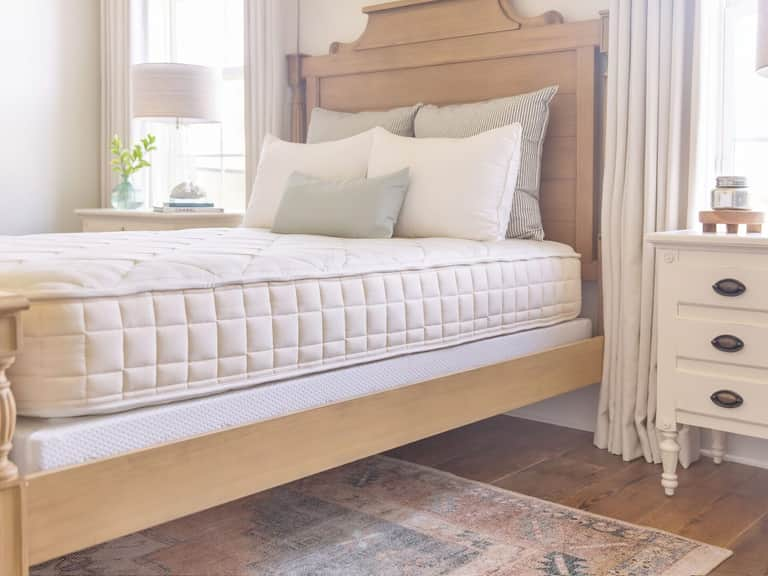
The Healthy Choice Sage is described as an organic Dunlop latex model. That description gives shoppers a useful starting point, but it is not a complete specification. Before drawing conclusions about comfort or sustainability, verify the current product details directly: exact layer construction, latex firmness ratings, certifications, cover materials, mattress height, care requirements, and the company’s return or exchange terms. Those details can vary across products and can change over time.
This guide explains how to interpret the available information without treating broad claims as guarantees. It is intended to help you compare the Sage with your own comfort needs and bedroom setup—not to promise a particular result for every sleeper.
What Dunlop latex means—and what it doesn’t
Dunlop is a process used to produce latex foam. In broad terms, liquid latex is placed in a mold, heated, and then washed and dried. The result is an elastic foam that can be used as a mattress core or as one layer within a larger mattress. It is commonly associated with a substantial, springy response: pressure compresses the material, and it pushes back as the sleeper moves or changes position.
That description is a general tendency, not a reliable bedside forecast. A Dunlop layer can be made in different firmnesses and thicknesses. A single firm slab will not feel the same as a softer comfort layer placed over a firmer support layer. A quilted cover, wool batting, or other upholstery can also change how the surface feels on first contact. The mattress’s foundation matters, too: an approved, supportive base can help the mattress perform as intended, while an unsuitable one may affect its feel or durability.
Natural latex and organic latex are related terms, but they are not interchangeable proofs of origin or certification. “Natural latex” generally describes latex derived from rubber-tree sap, though shoppers should examine the full material disclosure rather than infer a specific composition from the phrase alone. “Organic” is a claim that should be supported by clear documentation. Ask which components are certified, which organization issued the certification, and whether the certification applies to the latex itself, the finished product, or another part of the construction.
The feel: buoyant support, not a universal firmness
Many sleepers describe latex as responsive. Instead of slowly molding around the body, as some memory foams do, latex tends to compress and rebound more quickly. That lively response can make rolling over or changing sleep positions feel easier. It may also create a floating or gently lifted sensation rather than a deep, slow sink.
But “responsive” is not the same as “soft,” and “firm” is not the same as “supportive.” A mattress can feel firm at the surface while still compressing beneath heavier parts of the body. Conversely, a plush surface can feel comfortable at first but fail to keep the spine in a comfortable position for a particular sleeper. The useful question is not simply, “Is the Sage firm?” It is, “Does the Sage allow my shoulders and hips to settle while keeping my body comfortably supported?”
Firmness numbers, when supplied, can help compare layers within a manufacturer’s range. They are not a universal scale across every brand. Ratings may use different methods, and the same nominal firmness can feel different depending on layer thickness, cover construction, bed frame, and body weight. If the Sage’s exact firmness rating is not available in current documentation, do not try to infer it from the word “Dunlop.” Request the rating and ask what method or scale the seller uses.
Pressure relief and sleep position
Side sleepers often need enough give at the shoulder and hip to reduce concentrated pressure, while still receiving support through the torso and waist. Back sleepers may prefer a surface that cushions the lower back without allowing the pelvis to sink excessively. Stomach sleepers commonly look for a firmer, more even surface that limits too much midsection dip. These are starting points, not rules: body shape, weight distribution, pain history, and personal comfort all influence what works.
A latex mattress can suit different sleeping positions when its firmness and construction are appropriate. If a model has only one fixed firmness, it may be a compromise for couples with contrasting preferences. If it has configurable layers, confirm precisely what can be changed, whether each side can be configured independently, and whether a comfort exchange is available. Do not assume customization simply because latex layers are sometimes sold separately.
Motion, edge feel, and temperature
Latex’s quick response can make movement feel less restricted, though a mattress’s ability to isolate motion depends on its full construction. Couples should test whether a partner’s movements travel across the bed, particularly if one person is a light sleeper. Edge support is another separate consideration. A mattress may feel supportive in the center but compress more near the perimeter; shoppers who sit on the edge or use the full surface should assess that directly.
Some sleepers find latex more breathable than dense, slow-response foams, but perceived temperature depends on more than the core material. Covers, protectors, sheets, room temperature, humidity, and individual heat sensitivity all play a role. A waterproof protector, for example, can alter the surface feel and airflow, so it is worth considering the entire bedding system rather than judging the mattress in isolation.
Materials: read the whole construction, not the headline
A mattress is a stack of materials, and each layer has a job. The latex core may provide most of the resilience and support. The outer cover protects the interior and contributes to the hand-feel. Any quilting or batting can soften the initial impression. Additional components may include wool, cotton, or other fibers. For a careful materials review of the Healthy Choice Sage, look for a complete layer-by-layer description rather than a single phrase such as “organic latex.”
Check whether the product information identifies the latex as Dunlop and specifies whether it is natural, organic-certified, or a blend. Look for the certification name and scope, not just a certification logo. For textiles, ask whether cotton or wool is certified and whether the certification refers to the fiber, processing, or finished goods. These distinctions matter because a mattress can contain components with different origins and standards.
Certifications answer particular questions; they do not establish that a mattress is the best choice for every person or that it will cure a health condition. Standards may address organic fiber production, chemical restrictions, environmental criteria, or manufacturing practices. They are not all equivalent. If chemical sensitivity or a specific health concern is part of your decision, consult appropriate health professionals and obtain the manufacturer’s complete materials disclosure. Avoid relying on broad “non-toxic” language without evidence that clarifies what the claim means.
- Ask for a component list: Request details for the latex, cover, quilting, flame barrier, adhesives, and any other materials.
- Confirm the certification: Identify the certifier, certificate holder, and the exact components covered.
- Check for blends: Clarify whether the latex contains synthetic material or whether the cover combines different fibers.
- Review the fire-safety design: Ask how the mattress complies with applicable flammability requirements and what materials form the barrier.
- Get current documents: Product pages and certificates can be revised; request current details for the exact model and size.
Such questions are not a test of a seller’s sincerity. They are ordinary due diligence for a significant purchase. Clear, specific answers make it easier to compare products on their actual construction rather than on a broad category label.
Who might find the Sage a good fit?
The model may be worth considering if you are specifically looking for a latex sleep surface and value an elastic, responsive feel. Dunlop latex may appeal to people who prefer a mattress that rebounds quickly rather than allowing a deep, slow sink. Shoppers interested in organic materials may also see the Sage as a candidate—but should verify which parts of the mattress are certified before treating “organic” as a description of the entire product.
It may be a less obvious match for someone who wants a pronounced memory-foam hug, a very soft pillow-top sensation, or a highly adjustable comfort system, unless the current Sage specification confirms those features. People who need substantial pressure relief should pay particular attention to surface firmness and layer design. A firm label may be uncomfortable for some side sleepers; a softer surface may be unsuitable for someone who needs more resistance. Testing and a well-defined trial policy matter more than category stereotypes.
Couples should compare both sleepers’ needs, including preferred firmness, sleep position, motion sensitivity, and body size. If the mattress cannot be configured by side, a single feel may not satisfy both people equally. If one sleeper has significant pain, numbness, or a diagnosed condition, mattress selection is not medical treatment; a clinician can help distinguish comfort preferences from issues that need professional care.
A practical way to assess fit
When trying the Sage in person, spend enough time in your usual sleeping positions to notice what happens at the shoulders, hips, and lower back. A quick sit or bounce can reveal little about overnight comfort. If testing at home, give yourself time to adapt, but pay attention to persistent discomfort rather than assuming that every problem will disappear with a break-in period.
- Start with posture. Lie in your normal position and notice whether your body feels level and relaxed, without a pronounced dip or forced arch.
- Check pressure. On your side, assess shoulder and hip comfort. On your back, notice whether the surface feels supportive without creating a gap or pressure point.
- Move naturally. Roll, sit up, and change positions. The latex’s bounce may feel helpful to some and too lively to others.
- Consider the edge. Sit and lie near the perimeter if you use that area regularly.
- Use your own bedding. Your protector and sheets can affect temperature and the feel of the surface.
- Read the trial terms. Confirm how long the trial lasts, when it begins, whether exchanges cost extra, and what condition the mattress must be in for a return.
Also confirm the mattress’s exact dimensions and height, the recommended foundation, delivery arrangements, and any weight or support limits stated by the maker. If the Sage is intended for an adjustable base, verify that the specific model is compatible and follow its setup instructions. A suitable base is not a decorative afterthought; it is part of the system supporting the mattress.
Care, protection, and long-term expectations
Latex generally does not require the same routine as a washable household textile. The cover may be removable without being washable, so check the care label before opening or cleaning it. If the cover is not designed to be removed, spot cleaning may be the only recommended method. Excess moisture, harsh cleaners, or improvised washing can damage the materials or affect a warranty.
A breathable, appropriately sized mattress protector can help guard against spills, sweat, and everyday soil. Choose one that fits the mattress depth and does not create a surface feel you dislike. Rotate or flip the mattress only if the manufacturer permits it; construction varies, and some models are designed to be used one way up. Follow the stated foundation requirements and keep the mattress dry and well ventilated.
Longevity depends on the quality and design of the materials, use, support beneath the bed, care, and the conditions in the room. No material is immune to wear, and a natural or organic claim does not guarantee an unlimited lifespan. Read the warranty for what it actually covers—such as defined structural defects—and what it excludes, including normal softening, stains, or damage from an unsupported base.
The questions to settle before choosing
The Healthy Choice Sage Dunlop latex model should be evaluated as a complete sleep surface, not as a material name. Its likely character can be discussed in general terms—latex is often buoyant and quick to respond—but a confident judgment about this specific model requires current, model-specific specifications. Those details establish whether it is a single firmness or configurable, which layers it contains, what “organic” covers, and how it should be maintained.
Before purchasing, ask the seller for the current construction sheet, certification documents, firmness information, recommended base, care instructions, warranty, and trial or exchange policy. Then compare those answers with your own sleep position, comfort preferences, and household needs. If the details are clear and the feel suits you in a meaningful trial, the Sage may be a considered choice. If key information remains vague, pause and request clarification.
The point is not to find a mattress that wins every category. It is to find a surface whose materials you understand, whose support feels right to your body, and whose care and return terms make sense for your home. With latex, the difference between a promising description and a good fit lies in the details.